
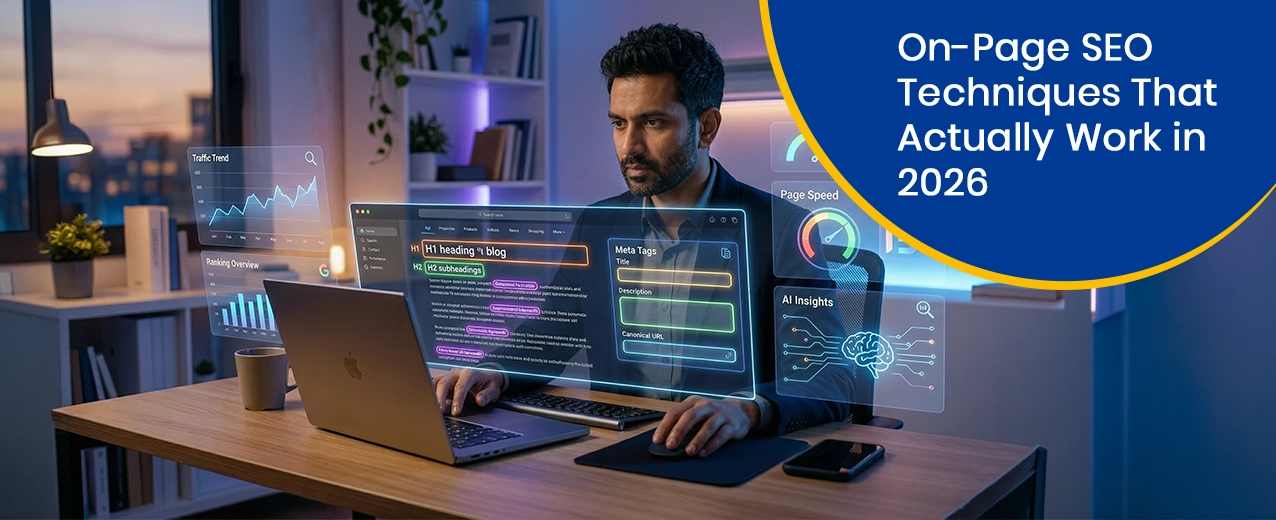
On-Page SEO Techniques That Actually Work in 2026
Search engines like Google, Bing, Yahoo and others are constantly changing. They’re getting smarter at understanding what people are searching for and which content truly deserves to rank.
Backlinko reports that the #1 result in Google gets 27.6% of all clicks. So, if you want your website to appear at the top of search results, simply publishing content isn’t enough. You need to structure and optimise your pages properly so both users and search engines can easily understand them.
That’s where on-page SEO comes in. It helps improve visibility, attract the right audience, and turn visitors into customers.
In this blog, we’ll walk through the essential on-page SEO techniques that actually work in 2026.
What is On-Page SEO?
On-page SEO is the process of optimising the content for search engines, LLM, and the readers. This includes refining elements directly on your website, such as:
- Page titles and meta descriptions
- Headings and content structure
- Keywords and content relevance
- Internal linking
- URL structure
- Images and alt text
- Page speed and mobile usability
When these elements are properly optimised, your website becomes easier to find, easier to read, and more likely to convert visitors.
Importance of On-Page SEO in the LLM Era
- Improves your rankings on Google and Bing, which still drive the majority of organic website traffic, even with the rise of AI tools like ChatGPT.
- Structures content with headings and schema so AI tools can easily scan and cite it.
- Gets your site mentioned in AI responses, increasing brand visibility.
- Shows expertise and trust (E-E-A-T) to search engines and LLMs.
- Improves user experience with fast, mobile-friendly pages that keep visitors engaged.
- Future-proofs your site against AI search changes.
On-Page SEO Checklist for 2026: 6 Best Practices
Use this checklist to make sure your pages are properly optimised.
1. Build a Strong Content Structure
Writing a blog post is like building a tree. You need a strong foundation and a clear way for the branches to grow. This hierarchy helps readers scan your page quickly. It also helps search engines map out your ideas.
- The H1 tag is your tree trunk. The H1 tag is the title of your article. It is the most important heading. You should only use one H1 tag per page. This tag tells everyone exactly what the page is about. If your topic is “The Benefits of Exercising,” that should be your H1.
- Use H2 and H3 tags for branches. H2 tags are like the big branches on your tree. They break your main topic into smaller sections. For a post about exercise, your H2 headings might be: Physical Health Benefits, Mental Health Benefits, How to Start Exercising
- H3 tags are smaller branches. They go inside the H2 sections. Under “Physical Health Benefits,” you might use H3 tags for “Heart Health” or “Muscle Strength.” This keeps your thoughts organized.
2. Use Interlinks Strategically
Internal linking is one of the most powerful tools for your website. An internal link is a link from one page on your site to another page on the same site. This helps search engines see that you have a lot of helpful information on a topic.
When search engine robots visit your site, they act like explorers. They crawl one page and then follow the links on that page to find new ones. If you link your articles together, you show that your site has depth. This makes your whole website look like a high-quality source of information.
3. Choose the Best Anchor Text
Anchor text is the clickable text in a link. It tells people and search engines what to expect on the next page. You must be careful not to use the same anchor text for every link.
Imagine you have three different pages:
- SEO Tips
- SEO Mistakes
- SEO Checklist
If you use the word “SEO” as the link text for all three, search engines will get confused. They won’t know which page is the most important for that word. Instead, use specific phrases like “SEO mistakes” when linking to that page. This prevents confusion and improves rankings.
4. Optimise URL Structure
Your URL is the web address of your page. It is a vital part of your SEO foundation. If you have an old site that is already ranking well, do not change your URLs. Changing them can negatively impact your traffic. But if your site is new, you should set them up correctly from the start.
Best Practices for Permalinks: In WordPress, you can change your URL settings under “Permalinks.” Many sites use dates or numbers in their URLs by default. This is not a good idea. Numbers and dates make URLs long and hard to remember. If you update an old post, a date in the URL will make it look old.
The best choice is the Post Name structure. This uses your title as the URL slug. It is short and clean and tells search engines exactly what is on the page. Keep your total URL length under 75 characters for the best results. For example: website.com/benefits-of-exercise
5. Optimize Meta Titles and Descriptions
When you search for something on Google, the first thing you see is the meta title. This is the blue link you click on. Right below it is the meta description. These two things are your only chance to grab a searcher’s attention.
How to write meta titles that get more clicks?
Your meta title should include your main keyword. It should also be interesting. Using numbers in your title often helps more people click. For example, “5 Great Benefits of Exercise” usually performs better than just “Benefits of Exercise.” Try to keep your title under 60 characters so it doesn’t get cut off.
How to write a meta description?
The meta description should explain what the reader will learn. If the description matches what the person is looking for, they will click your link. Even though search engines sometimes write their own descriptions, you should always write a custom one. It acts like a short ad for your content.
Want more clicks? Learn how to write better title tags and meta descriptions in our detailed guide. Read the blog.
6. Right Keyword Placement
Keywords are the words people type into search engines. You need to put these words in specific spots so search engines know your page is a good match. However, you must not overdo it.
You should place your main focus keyword in these areas:
- The Meta Title
- The URL Slug
- The Meta Description
- The first 10% of your content
- At least one heading (H2 or H3)
- The Alt Text of your first image
Always make sure the words sound natural. Do not force keywords where they don’t belong. This is called “keyword stuffing,” and it can get your site penalized.
7. Optimise Images with Alt Text
Search engines cannot “see” images. They rely on Alt Text to understand what an image shows.
Alt Text is important because:
- It helps visually impaired users using screen readers
- It displays if images fail to load
- It gives search engines context
Describe images clearly and simply.
Use your main keyword in only one important image to avoid looking spammy.
Conclusion
On-page SEO is still a vital part of growing your website traffic. If you follow these steps, you will be well on your way to better search rankings. If you want to make this process even easier, you can reach out to Webboombaa, a leading SEO company in Chennai. Connect with the experts.
Frequently Asked Questions (FAQs)
You should review your on-page SEO every 3–6 months, or whenever search engine updates happen.
A technical SEO checklist includes tasks like improving site speed, fixing broken links, making your site mobile-friendly, optimising crawlability, and ensuring proper indexing.
Answer questions clearly and directly. Use short paragraphs, bullet points, numbered lists, and structured headings. Keep answers simple and focused.
On-page SEO focuses on improving content and structure on your website.
Off-page SEO focuses on building authority through backlinks and external signals from other websites.
Webboombaa is one of the leading digital marketing companies in Chennai, known for delivering strong on-page SEO strategies focused on rankings, traffic growth, and measurable results.